Looking for a data analytics consultant in Portugal? The focus should be on finding a partner who can turn your business data into better decisions, not simply someone who can build dashboards or create reports. The best data analytics consultants help businesses identify growth opportunities, improve operational efficiency, understand customer behaviour, automate reporting, and establish reliable performance metrics. In this guide, you’ll learn the seven key factors to consider when choosing a data analytics consultant in Portugal, from evaluating industry experience and technical expertise to assessing business understanding, reporting capabilities, and long-term strategic value. At BluTree, we help startups, SMEs, and growing businesses across Portugal transform fragmented data into practical insights through business intelligence, analytics, reporting automation, modern data platforms, and data-driven decision-making.
Why Should a Business Hire a Data Analytics Consultant?
Businesses today generate more data than ever before:
- Website traffic data
- Customer behavior data
- Sales data
- Inventory data
- Marketing campaign performance
- Financial and operational metrics
The challenge is not collecting data, but utilizing it. The value of a consultant isn’t simply in producing another report. A good analytics partner helps connect the data you already have with the questions your business needs to answer.
A skilled data analytics consultant helps businesses:
- Identify hidden opportunities
- Reduce operational inefficiencies
- Improve customer acquisition and retention
- Forecast future performance
- Support strategic decision-making
- Build sustainable reporting systems
Rather than relying on intuition, companies can make decisions backed by evidence and measurable outcomes.
7 steps to choosing the right data analytics consultant for your business
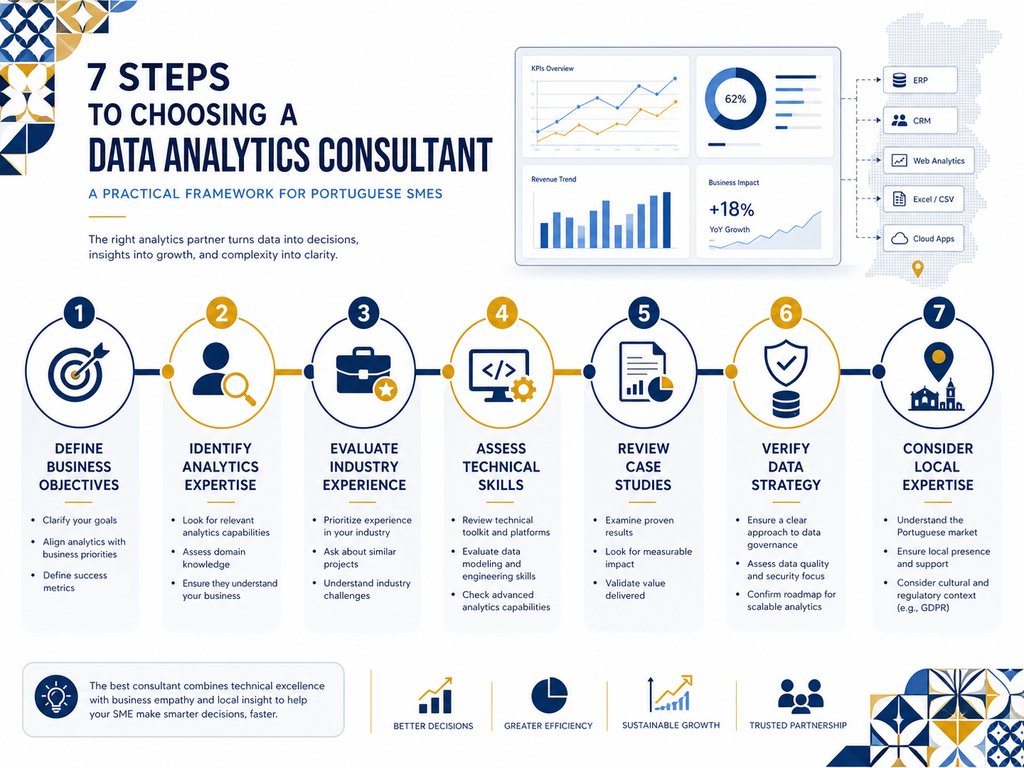
Step 1: Define Your Business Objectives First
Before contacting any consultant, clarify what you want to achieve. Many projects fail because companies focus on tools instead of business outcomes.
Ask yourself:
- Do you want to increase revenue?
- Improve customer retention?
- Reduce costs?
- Optimize inventory?
- Automate reporting?
- Improve marketing ROI?
- Build executive dashboards?
For example:
Startup
A startup may need performance dashboards that track growth metrics and investor reporting.
SME
An SME may want visibility into sales performance across different locations.
E-commerce Business
An e-commerce company may seek customer segmentation, conversion analysis, and product profitability insights.
The clearer your objectives, the easier it becomes to evaluate potential consultants. As a result, a consultant who starts by asking about your business objectives is usually a better sign than one who starts by recommending a particular software platform.
Step 2: Determine What Type of Analytics Expertise You Need
Data analytics covers several disciplines. However, not every consultant specializes in all areas.
Best suited to businesses that need better reporting, dashboards, KPIs and management visibility.
Useful when you need to understand performance, trends, customer behaviour or operational problems.
Predictive Analytics
Useful when the business wants to use historical data to forecast likely future outcomes.
Data Engineering
Important when data is fragmented across multiple systems and needs to be integrated, cleaned or automated before meaningful analysis can happen.
In practice, these capabilities often overlap. A good analytics partner should be able to tell you which combination you actually need rather than selling you every service available.
Step 3: Evaluate Industry Experience
Relevant industry experience can shorten the learning curve and help a consultant understand the business questions behind your data more quickly. While strong analytical skills are important, domain knowledge often shortens implementation time and improves recommendations.
Startups
Look for experience with:
- Growth metrics
- Fundraising reporting
- SaaS KPIs
- Customer acquisition
SMEs
Look for expertise in:
- Operational efficiency
- Business process improvement
- Financial reporting
E-commerce
Look for experience with:
- Customer lifetime value (CLV)
- Conversion rates
- Cart abandonment
- Marketing attribution
- Product analytics
Retail & Hospitality
Look for capabilities in:
- Demand forecasting
- Customer segmentation
- Inventory optimization
Real Estate
Look for experience with:
- property market data
- pricing trends
- demand analysis
- investment analysis
- demographic indicators
A consultant who has solved similar challenges before will typically identify opportunities more quickly.
Step 4: Assess Technical Skills and Tool Expertise
A capable analytics consultant should understand the tools required to solve your problem, but technical knowledge should support the business objective rather than become the objective itself.
Analytics & BI: Power BI, Excel, Microsoft Fabric
Data: SQL, databases, data warehouses
Cloud: Azure and other cloud platforms
Marketing & customer data: GA4, CRM and e-commerce platforms
The goal is selecting the consultant with the tools that match your business requirements.
Step 5: Review Case Studies and Past Results
Always request examples of previous work. Don’t ask what they built. Ask what changed.
A dashboard is a deliverable. Better visibility, faster reporting, reduced costs or improved decision-making are business outcomes. More importantly, the strongest consultants are able to demonstrate business outcomes, not just technical deliverables. Focus on impact, not features.
Instead of asking: “Can you build dashboards?”
Ask: “What business outcomes did those dashboards achieve?”
Step 6: Verify Their Data Strategy Approach
A good consultant does more than produce reports. They should understand how data supports broader business objectives.
Ask how they approach:
- KPI development
- Data governance
- Data quality
- Performance measurement
- Change management
The best consultants help executives answer business questions rather than simply delivering visualizations. If conversations immediately focus on software before understanding your business goals, that’s worth treating as a warning sign.
Step 7: Consider the Benefits of Working with a Local Portuguese Consultant
Remote collaboration has become common, but local expertise remains valuable. Consequently, a consultant based in Portugal can often provide:
Better Understanding of the Market
They understand:
- Local business culture
- Consumer behavior
- Regulatory requirements
Easier Collaboration
If needed, face-to-face workshops can accelerate project success.
Shared Time Zone
Communication becomes faster and more efficient.
Stronger Long-Term Relationships
Many analytics initiatives evolve over time. Local availability can make ongoing support easier.
For businesses located in Lisbon, Porto, Braga, Coimbra, or surrounding areas, working with a local consulting partner may provide additional advantages. However, a consultant’s ability to understand your business, demonstrate relevant experience and deliver measurable results matters more than simply having a Portuguese address.
Bonus Step: Understand the cost of data analytics consultation in Portugal
One of the most common questions businesses ask is:
“How much does a data analytics consultant cost in Portugal?”
The answer depends on several factors. Industry pricing directories indicate that many BI and data consulting firms serving the Portuguese market charge hourly rates ranging from approximately €25 to over €100 per hour, depending on expertise, project complexity, and company size. So, it has never been a one-cap-fits-all scenario.
For more on this, please find our article on pricing for data analytics consultancy in Portugal.
Choosing the Right Data Analytics Consultant
Choosing a data analytics consultant is ultimately less about finding the person who knows the most tools and more about finding a partner who understands what your business needs to achieve.
Before making a decision, ask:
Do they understand our objectives?
Have they solved similar problems?
Can they work with our existing data and systems?
Can they help us turn analysis into decisions?
The right analytics partner should not simply give your business more reports. They should help you understand what is happening, why it is happening and what you can do about it.
For Portuguese startups and SMEs, that can turn data from an underused business resource into a practical tool for improving performance, managing uncertainty and identifying opportunities.
Important to note: For businesses operating in Portugal and across the European Union, data privacy cannot be ignored. The GDPR (General Data Protection Regulation) establishes strict requirements regarding the collection, storage, and processing of personal data.This will be discussed in another blog post here.
For businesses looking for a data analytics partner in Portugal, BluTree works with startups and SMEs in Lisbon and across the country, helping organisations turn business data into clearer reporting, better insights and more informed decisions.
Book a virtual consultation with our team today or simply send an email.
Recommended articles for You
Real-Time Data Integration Services in Portugal: Automate Reporting and Business Insights
Real Estate Data Analytics in Portugal: Can Data Predict the Next Property Market Shift?
Frequently Asked Questions when Hiring a Data Analytics Consultant
A data analytics consultant helps businesses collect, organise and analyse their data to identify trends, improve performance, solve operational problems and support better business decisions.
An analytics consultant can help SMEs turn fragmented business data into useful insights, reduce manual reporting, identify inefficiencies and make decisions based on evidence rather than assumptions.
The cost varies depending on the project’s complexity, number of data sources, reporting requirements, integrations and level of ongoing support. A clear definition of the business objective is usually the best starting point for estimating costs.
Look for a consultant who combines technical expertise with business understanding, relevant industry experience, proven results and the ability to work with your existing data, systems and objectives.
It depends on your needs. If your main requirement is dashboards, reporting and KPI visualisation, a Power BI consultant may be appropriate. If you need broader analysis, forecasting, data integration or strategic insight, a wider data analytics service may be more suitable.
Yes. A good analytics consultant should be able to work with existing databases, spreadsheets, CRM and ERP platforms, cloud services and other business systems. Integrating existing data is often an important part of an analytics project.
Local expertise can provide advantages such as familiarity with the Portuguese business environment, easier communication and opportunities for in-person collaboration. However, industry experience, technical capability and the ability to deliver measurable business results should remain the most important criteria.