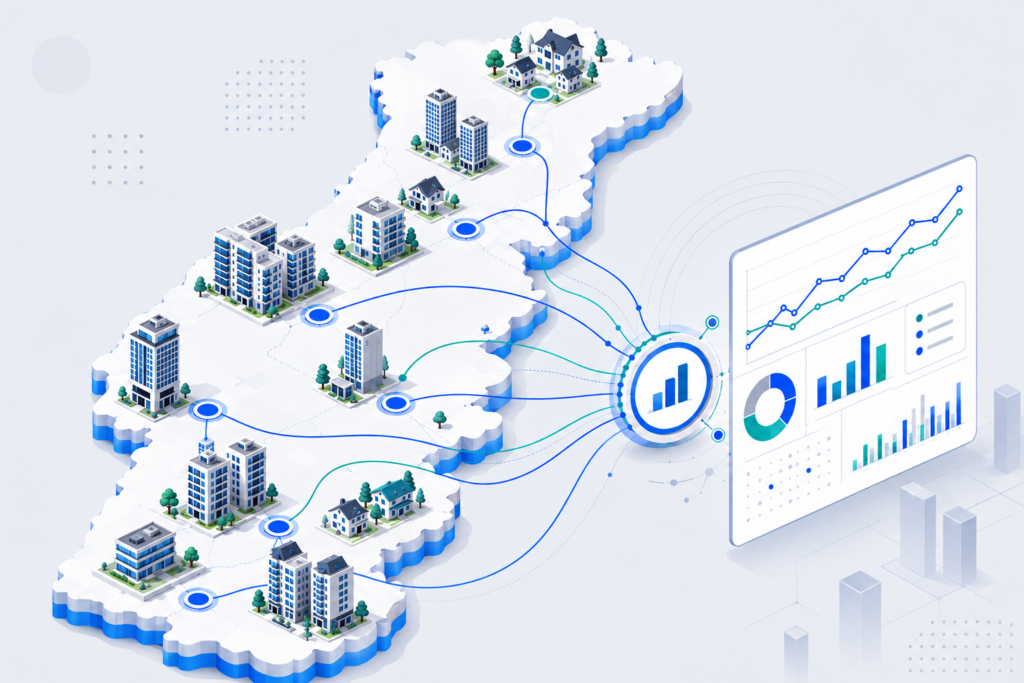
If you’re wondering how much data analytics consulting costs in Portugal, the short answer is that it depends on the business problem you’re trying to solve, the quality of your data, the number of systems involved, and the level of insight you’re looking to generate. A simple Power BI dashboard connected to a few clean data sources will cost significantly less than a project involving data integration, automated reporting, predictive analytics, machine learning, or ongoing decision-support capabilities. In this guide, you’ll learn what typically affects the cost of data analytics consulting in Portugal, what different types of analytics projects involve, how consultants charge for their services, and how businesses can evaluate proposals more effectively. At BluTree, we help startups, SMEs, and mid-sized organisations across Portugal transform fragmented business data into meaningful insights through data analytics, business intelligence, reporting automation, predictive modelling, and modern data platforms.
Cost of data analytics consulting in Portugal
Industry directories show a broad market range. Many business intelligence and data consulting providers serving Portugal publish rates around €25–€99 per hour, while more specialised providers and senior consultants can charge €100 per hour or more. Some local data-treatment providers quote roughly €45–€200 per hour, illustrating how specialist work can sit above typical BI implementation rates.
Many businesses underestimate the amount of work required before useful analytics can begin. The dashboard is often the most visible part of the project, but the real effort frequently happens behind the scenes. Data may need to be extracted from multiple systems, cleaned, standardised, integrated, modelled, governed, and validated before reliable reporting becomes possible. For example, a business looking to track sales performance across a CRM, ERP, e-commerce platform, and accounting software is solving a very different problem from a company that simply wants a monthly management dashboard. Understanding these differences can help businesses budget more accurately and avoid comparing analytics proposals based solely on hourly rates or headline project costs.
Typical Pricing complexity table
Engagement type | Indicative pricing approach | Typical scope |
Basic dashboard or reporting project | Lower end of the market | One or two data sources, straightforward KPIs, limited reporting requirements |
Small-business analytics project | Mid-range project fee or hourly engagement | Data cleaning, several sources, recurring dashboards, initial insight generation |
Data cleaning, several sources, recurring dashboards, initial insight generation | Mid-to-high hourly or fixed-price engagement | Multiple databases, APIs, data pipelines, governance, customised reporting |
Predictive analytics or machine-learning project | Higher specialist rate | Forecasting, segmentation, propensity models, experimentation, model deployment |
Retained support and optimisation | Monthly retainer or support package | Dashboard maintenance, data-quality monitoring, new reports, training, optimisation |
Published Portuguese-market listings commonly cluster around €25–€49 and €50–€99 per hour, with some Lisbon-based specialist firms listed at €100–€149 or higher. Freelance marketplace listings also show a wide spread, reflecting differences in seniority, technology expertise, and the commercial model used.
What Determines the Cost of Data Analytics Consulting?
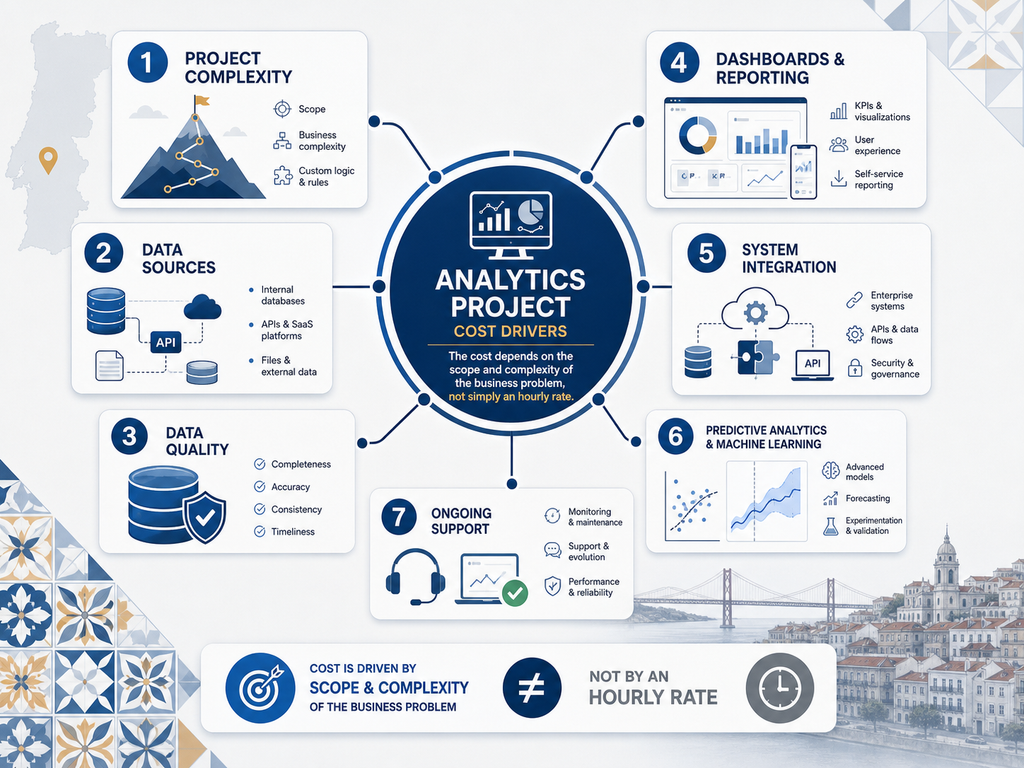
The hourly rate is only one part of the cost. A consultant’s total price depends more heavily on the amount of discovery, preparation, engineering, analysis, and implementation the project actually requires. The visible dashboard may take only part of the project effort; the most valuable work often happens underneath it.
Project complexity
A simple assignment might involve building a sales dashboard in Power BI from a clean Excel export. A more complex engagement may involve defining business metrics, reconciling conflicting figures between teams, designing a reporting architecture, and creating automated data pipelines.
Simple dashboards cost significantly less than enterprise-wide analytics programmes because there are fewer moving parts and less risk to manage.
Data sources and systems
The number and type of sources matter. A company working from two or three structured sources—such as a CRM, an e-commerce platform, and accounting software—may need comparatively limited integration.
Costs rise when data is distributed across multiple databases, legacy applications, spreadsheets, marketing platforms, APIs, cloud systems, or departmental tools. Each additional system can introduce issues around data access, data definitions, duplicate records, refresh schedules, and security.
Data quality
Data quality is often the hidden driver of analytics costs. Missing values, inconsistent customer IDs, duplicate records, mismatched product names, incomplete dates, and unclear definitions can require substantial preparation before analysis is reliable.
A consultant cannot produce trustworthy insights from unreliable data without first investing time in cleaning, validation, and standardisation.
Dashboard and reporting requirements
A single executive dashboard with a few agreed KPIs is very different from a reporting suite used by sales, marketing, finance, operations, and leadership.
Costs increase when the project needs:
- Multiple dashboards for different users.
- Role-based access and permissions.
- Automated scheduled reporting.
- Drill-down analysis.
- Custom calculations and data models.
- Training and documentation.
- Ongoing dashboard revisions.
Integration requirements
Integrating systems is usually more complex than connecting a dashboard to a spreadsheet. It can require API work, data pipelines, warehouse design, automated refresh processes, authentication setup, monitoring, and error handling.
Advanced cloud and data-engineering environments often require specialised expertise, which can increase both the hourly rate and the overall project budget.
Predictive modelling
Descriptive reporting answers questions such as “What happened?” Predictive modelling attempts to answer questions such as “What is likely to happen next?” or “Which customers are most likely to churn?”
Projects involving forecasting, customer segmentation, lead scoring, demand prediction, or machine-learning models require more advanced skills, model validation, and monitoring. They are therefore generally priced above standard dashboard or reporting work.
Ongoing support
Many organisations need help after the initial implementation. Monthly support may include refreshing dashboards, adding metrics, solving data issues, improving performance, supporting users, documenting processes, and refining models.
This is commonly priced separately through a monthly retainer, support hours, or a service-level agreement rather than being included in the original implementation quote.
How Business Size Affects Data Analytics Costs
Small Business vs Large Organisation
A small business with clean data from two or three sources may require a relatively straightforward analytics project. For example, a consultant could connect CRM, sales, and marketing data, build a practical dashboard, and identify a few opportunities to improve conversion, retention, or campaign performance.
A larger organisation may have fragmented systems, multiple databases, inconsistent definitions, legacy software, and complex reporting requirements across departments. In that situation, considerably more preparation may be needed before meaningful analysis can begin.
The first phase may involve data mapping, data-quality assessment, system integration, KPI definition, governance, and reporting design. The visible dashboard may take only part of the project effort; the most valuable work often happens underneath it.
Why Hourly Rates Can Mislead
Comparing consultants solely on hourly rates or their initial project quotes can be misleading.
A lower-rate provider may appear cheaper at first, but the outcome may be limited if they do not address data quality, integration, business definitions, or adoption by the team. Conversely, a more experienced consultant may charge a higher rate but complete the work faster, prevent costly errors, and create a solution that supports better decisions over time.
The more useful question is:
What business problem will this engagement solve, and what measurable value can it create?
For example, the value may come from:
- Reducing manual reporting time.
- Improving marketing spend allocation.
- Identifying high-value customers.
- Reducing customer churn.
- Improving sales forecasting.
- Automating recurring analysis.
- Improving inventory or operational decisions.
- Giving management a single trusted view of performance.
How Do Data Analytics Consultants Charge?
Hourly or Daily Rates
Useful when requirements are uncertain or the business needs flexible expertise.
Fixed-Price Projects
Suitable when the scope, deliverables and requirements can be clearly defined.
Monthly Retainers
Useful when a business needs ongoing reporting, dashboard maintenance, analytics support or continuous optimisation.
The best pricing model depends on the nature of the engagement. A fixed price can provide predictability, while hourly or retainer arrangements may offer greater flexibility when requirements are expected to evolve.
When hiring a data analytics consultant
When reviewing proposals from data analytics consultants in Portugal, focus on business outcomes rather than choosing the cheapest option. A strong proposal should clarify:
- The business problem being addressed.
- The data sources included and excluded.
- Expected data-cleaning or integration work.
- Key deliverables, such as dashboards, models, pipelines, or training.
- Assumptions, risks, and dependencies.
- Project phases and timeline.
- Ownership of dashboards, code, models, and documentation.
- Ongoing support options.
- How success will be measured.
Portugal has a growing technology and consulting ecosystem, giving businesses access to analytics expertise across a range of specialisms and pricing models.
The cheapest quote isn’t necessarily the best value, and the highest hourly rate isn’t necessarily the most expensive option.
What matters is whether the consultant can understand your business, work effectively with your data and deliver something that improves the way your organisation operates.
Before comparing prices, define the business problem you want to solve. Then ask each consultant how they would approach it, what data they would need, what they would deliver and how success would be measured.
That gives you something much more useful than an hourly rate: a way to evaluate the potential business value of the engagement.
At BluTree, we help businesses in Lisbon and across Portugal turn business data into practical insights through data analytics, business intelligence and tailored data solutions.
Book a virtual consultation with BluTree IT Solutions for that custom data analytics for that problem that may just hold the key to better decisions for your business.
Frequently asked questions about the cost of data analytics consulting in Portugal
The cost varies according to project scope, data complexity, consultant expertise, and delivery model. Simple analytics projects may cost considerably less than projects involving data integration, predictive modelling, or ongoing support.
A basic Power BI dashboard may cost a few thousand euros, while dashboards requiring multiple data sources, data modelling, automated refreshes, custom KPIs, and user access controls can cost considerably more. The final price depends on the project’s requirements.
A freelancer may be suitable for a focused analytics task or simple dashboard. A consultancy is generally better suited to larger projects involving multiple data sources, integration, data engineering, business intelligence, project management, and ongoing support.
It depends on the project. Hourly pricing can work well for exploratory or flexible assignments, while fixed pricing is often suitable for clearly defined projects. Monthly retainers can be appropriate for ongoing analytics, reporting, and optimisation.
Consultants may be quoting for very different levels of work. One proposal might cover a dashboard using clean data, while another includes data cleaning, system integration, KPI development, documentation, training, and ongoing support. Always compare the scope and deliverables, not just the headline price.
It can. Projects involving personal data may require additional measures for access control, data minimisation, security, retention, documentation, and governance. The impact depends on the type of data being processed and the project’s requirements.
Measure the business outcomes rather than the dashboard itself. Useful indicators include reduced reporting time, fewer errors, faster decision-making, improved forecasting, better marketing performance, increased retention, and reduced operational costs.