Why Go Custom? Going digital is no longer simply about putting your business online. For many businesses in Portugal, digital transformation solutions means changing how work gets done: the ways customers interact with the company, how employees manage information, how different systems communicate and how decisions are made.
And this creates an important question: Should you adapt your business to an existing software platform, or should you build a digital solution around your business? Invariably, why go custom?
There is no universal answer. Off-the-shelf software can be an excellent choice for common business requirements. Accounting, email, collaboration, CRM and many other everyday functions can often be handled effectively by established software platforms.
But businesses are rarely identical. The more distinctive your processes, customer experience, data requirements or growth plans become, the more likely you are to encounter the limitations of generic software. That is where custom software development and bespoke digital solutions can make a meaningful difference.
What Does “Going Custom” Actually Mean?
Custom software doesn’t necessarily mean building an enormous application from scratch. It can mean creating a digital solution specifically around a business requirement that existing software cannot adequately address.
That could be:
- A customer-facing web platform
- An internal business application
- A workflow automation system
- A booking or scheduling platform
- A customer portal
- A data integration solution
- A bespoke reporting platform
- An application connecting several existing systems
- A digital platform replacing manual or paper-based processes
The objective isn’t to use technology simply because it is custom. The objective is to make technology fit the business.
So, really, what are the reasons for which businesses in Portugal prefer a custom digital or software solution?
1. Your Customers Expect More Personalised Experiences
Customers have become accustomed to digital experiences that feel relevant to them. They expect businesses to remember their preferences, provide information quickly and make interactions simple.
Think about the difference between:
“Please fill out this form, email it to us, wait for someone to process it and we’ll get back to you.”
and:
“Log into your account, see your information, submit your request and track its progress.”
The difference isn’t simply aesthetic. It represents a fundamentally different way of designing a business around the customer’s experience. Generic software often gives businesses a predefined customer journey.
A custom digital solution allows that journey to be designed around your customers, your processes and your particular service. For businesses in Portugal competing on customer experience, this can become an important differentiator.
2. Your Business Shouldn’t Have to Work Around Your Software
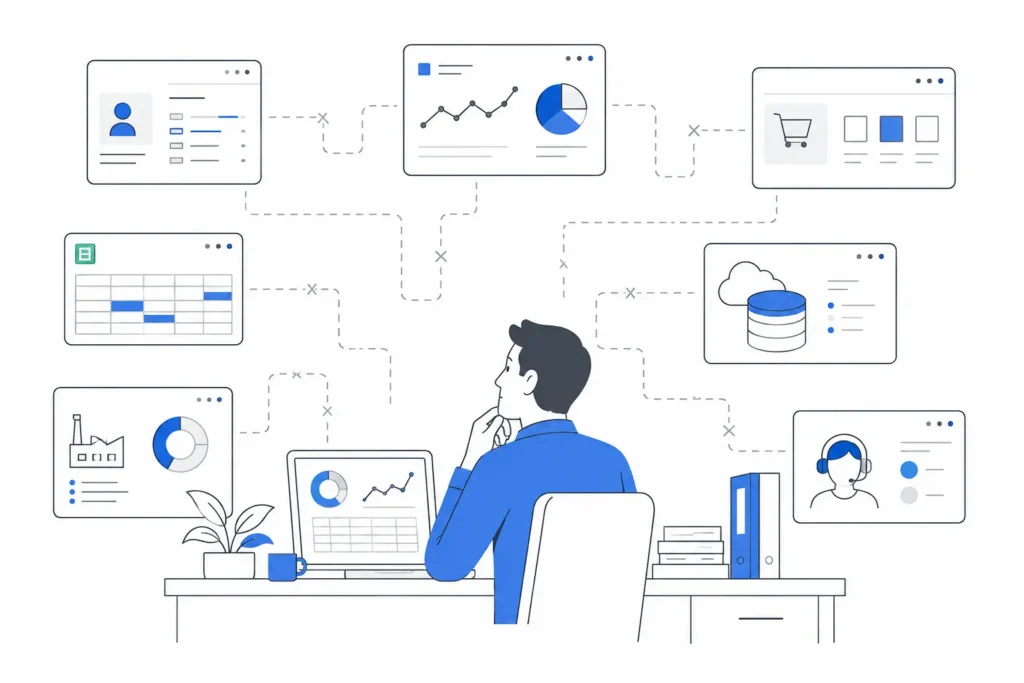
One of the clearest signs that a business has outgrown generic software is when employees begin creating workarounds.
Perhaps information has to be exported from one system and manually entered into another.
Perhaps employees maintain spreadsheets alongside an existing platform because the software doesn’t capture the information they actually need.
Perhaps staff have developed complicated procedures simply to compensate for limitations in the software.
These workarounds may appear harmless individually. Over time, however, they create:
- duplicated work
- inconsistent information
- manual errors
- unnecessary administration
- slower processes
- fragmented data
A custom digital solution starts from the opposite direction. Instead of asking:
“How do we make our business fit this software?”
the question becomes:
“What should the software do to support the way our business actually operates?”
That’s one of the fundamental principles behind effective digital transformation.
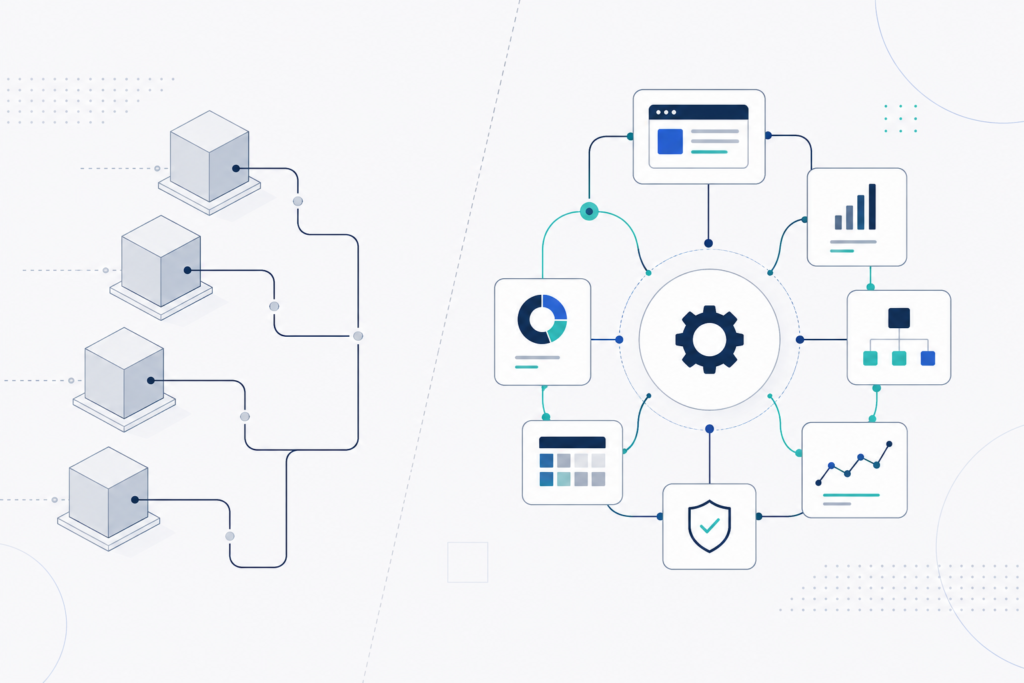
3. Your Systems Need to Work Together
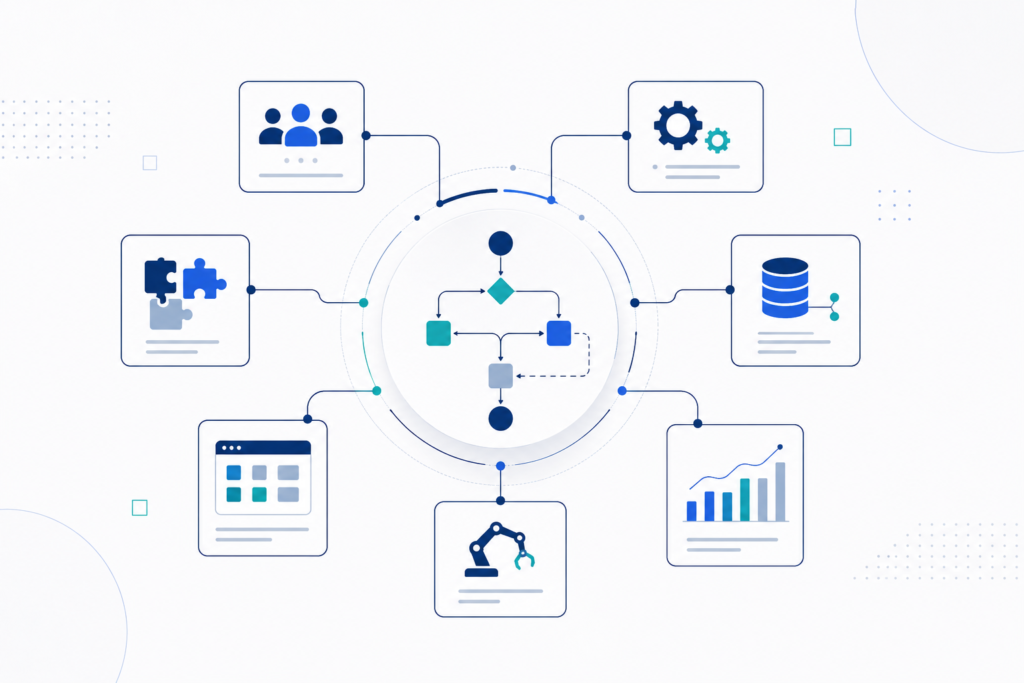
Businesses rarely operate on one piece of software. A growing organisation might use a CRM, accounting platform, ERP, booking system, e-commerce platform, internal database and several cloud services. Each may work perfectly well independently. The problem begins when they don’t communicate.
Employees end up moving information between systems manually. That is where bespoke software engineering and systems integration can create significant value. Instead of replacing everything, a custom solution can sometimes act as the connection between the systems you already use.
For example:
Customer enquiry → CRM → quotation → invoicing → fulfilment → reporting
Rather than requiring employees to manually transfer information between each stage, the appropriate systems can be connected so information moves automatically. Going custom doesn’t always mean replacing your existing software. Sometimes the smartest digital transformation is simply making your existing technology work together.
4. Custom Solutions Can Reduce Operational Friction
Businesses often look at software in terms of features. A better question is: How much unnecessary work does this software remove?
Imagine a company processing hundreds of customer requests every week. If employees have to:
- Receive an email
- Read the request
- Enter the information into a spreadsheet
- Copy it into another system
- Notify another employee
- Generate a report
- Update the customer manually
- Update the email list
there is an obvious opportunity for digital transformation. A tailored system could potentially automate much of that workflow. The result isn’t simply “better software.” It’s less administrative work.
That’s where custom digital solutions can produce tangible business value.
5. Your Business Has Requirements Generic Software Wasn’t Designed For
Generic software is designed to serve a broad market. That’s one of its greatest strengths. But it can also be its limitation. Your business may have a process that is unusual, highly specialised or central to the way you compete.
Perhaps you operate according to a particular approval process. Perhaps your customers require a specialised portal. Perhaps your business model involves calculations, workflows or integrations that aren’t supported by mainstream platforms.
In those situations, forcing the business to adopt a generic workflow can create unnecessary complexity. A bespoke solution allows the technology to reflect those requirements instead. Your competitive process becomes part of the digital architecture rather than something employees have to work around.
6. You Can Build for Where the Business Is Going
One of the biggest mistakes businesses can make is choosing technology purely around today’s requirements. A system might work perfectly when you have ten employees and 1000 customers. What happens when you have 100 employees and 50,000 customers?
Custom software gives businesses greater control over how their digital environment evolves. New functionality can be developed around changing requirements. Integrations can be added. Workflows can be redesigned. Customer experiences can evolve. Data structures can be expanded.
That doesn’t mean custom software is magically “infinitely scalable.” It means you have greater control over the direction of the technology rather than waiting for a software vendor to decide whether your requirements belong on its roadmap.
7. You Have Greater Control Over Your Data
Data is increasingly one of a company’s most valuable operational assets. When information is scattered across disconnected platforms, understanding the business becomes harder. A tailored digital ecosystem can be designed around how your organisation collects, stores, accesses and uses its information.
This can support:
- better reporting
- stronger data visibility
- more consistent information
- controlled access
- improved integration
- more effective business intelligence
For businesses operating in Portugal and the wider European market, data protection and security also need to be considered from the beginning. Custom development gives businesses an opportunity to incorporate appropriate security and data protection requirements into the architecture rather than treating them as an afterthought.
8. Custom Doesn’t Always Mean More Expensive
Custom software involves development, hosting, maintenance, security, updates and ongoing technical management. It can represent a significant investment. But the more useful financial question is:
What is the total cost of the problem we’re trying to solve?
If a business is paying for ten different platforms, maintaining spreadsheets, employing people to perform repetitive administrative tasks and losing time because systems don’t communicate, the “cheap” software may not actually be cheap. Sometimes the better investment is not another subscription.
It’s fixing the underlying process.
So, Should Your Business Go for a Custom Software Solution?
Not necessarily. And that’s an important part of the BluTree philosophy. If an established SaaS platform solves your problem efficiently, securely and affordably, use it. You don’t need custom software simply for the sake of having custom software.
But consider going custom when:
- Your processes are highly specific
- Existing software forces significant workarounds
- Your systems don’t communicate effectively
- Manual administration is consuming significant time
- Customer experience is central to your competitive advantage
- You need functionality that existing platforms don’t provide
- Your business requires greater control over its digital ecosystem
- You’re replacing paper-based or fragmented processes
- Your technology needs to evolve alongside your business
In those situations, bespoke software may be worth exploring.
Custom Digital Transformation Starts With the Business
The most important thing about custom software isn’t the code. It’s the understanding behind the code. Before deciding what technology to build, businesses need to understand how their people work, where information moves, where customers experience friction and where existing systems fall short.
That’s why effective Digital Transformation Solutions should begin with the business rather than the technology. At BluTree IT Solutions, we help businesses across Portugal identify opportunities to modernise manual processes, connect disconnected systems and develop digital solutions tailored to their specific operational requirements.
Sometimes the right answer is automation. Sometimes it’s integration. Sometimes it’s a new application. And sometimes, an existing software product is perfectly adequate.
The objective isn’t to build custom technology.
The objective is to build the right technology for the business.
Frequently Asked Questions about Custom Digital/Software Solutions
A custom digital solution is software or a digital platform designed around a business’s specific processes, requirements and customers rather than forcing the business to adapt to a generic system.
Off-the-shelf software can work well for common requirements. Custom software becomes valuable when a business has specialised processes, integration needs or customer experiences that generic platforms cannot adequately support.
Yes. Custom software can be particularly useful when a growing business is outgrowing spreadsheets, manual processes or disconnected systems. The solution can be designed around current needs while allowing the business to evolve.
Yes. A custom solution can connect existing platforms such as CRM, accounting, ERP, databases and other business applications, helping information move between systems without unnecessary manual work.
No. Digital transformation does not necessarily require replacing everything. In many cases, the better approach is to connect and improve the systems a business already uses and develop custom functionality where gaps exist.
Not necessarily. While custom development requires an initial investment, businesses should consider the total cost of their existing processes, including software subscriptions, manual administration, duplicated work and inefficient workflows.
BluTree helps businesses in Portugal identify operational inefficiencies and develop tailored solutions involving custom software, automation, systems integration, data and cloud technologies. The goal is to make technology work around the business rather than the other way around.