If you’re looking for an AI and business automation consultant in Portugal , it’s important to find a partner who understands your business processes and can identify where automation can create real value—not simply someone who knows the latest AI tools. A good AI consultant can help your company reduce manual work, simplify operations, improve customer experience, connect systems that currently operate in isolation, and make better use of existing data. Furthermore, effective implementation should be aligned with the company’s objectives and operational reality.
In this guide, you will learn the 7 essential steps to choosing an AI and business automation consultant in Portugal , from evaluating technical experience and knowledge of business processes to analyzing security, integrations, and long-term support. At BluTree, we help startups, SMEs, and medium-sized companies in Portugal identify practical automation opportunities, implement AI solutions, automate workflows, and create scalable digital foundations to support long-term growth.
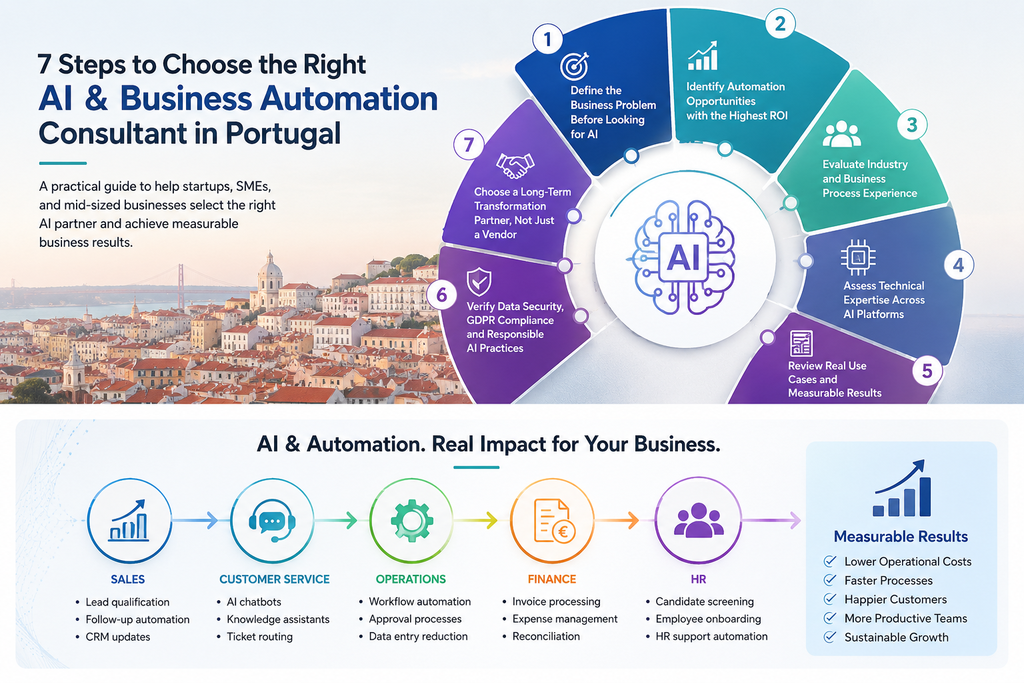
7 Steps to Choosing the Right AI and Business Automation Consultant in Portugal
Step 1: Define the Business Problem Before Looking for an AI Solution
The first question should not be:
“How can we use AI?”
Instead, it should be:
“What problem are we trying to solve?”
AI is a technology, not a business objective.
Therefore, companies often turn to AI and automation when facing problems such as:
- Excessive manual data entry
- Repetitive administrative work
- Long response times to customers.
- Time-consuming reporting
- Workflows that are disconnected from each other.
- High operating costs
- Complex document processing
- Lack of visibility into business processes
For example, a company that spends several hours a week extracting information from invoices may not need a sophisticated AI platform. Instead, it may simply need an automated document processing workflow capable of extracting the relevant information and sending it directly to the accounting system. In this way, starting with the business problem helps avoid unnecessary investment in technology.
Look for an AI consultant who starts with your processes.
A good AI consultant should start by understanding how your organization works, identifying where inefficiencies exist, and determining whether the right solution is AI, automation, integration, or a combination of these technologies.
Therefore, when evaluating an AI and business automation consulting firm in Portugal, look for a partner that first analyzes the process and only then recommends the technology.
Step 2: Identify the Automation Opportunities with the Greatest Potential for Value
After understanding the business problem, the next step is to identify where automation can make a significant difference.
However, not all processes should be automated .
The best opportunities are often found in processes that are repetitive, rule-based, time-consuming, or dependent on processing large volumes of information.
Sales
AI and automation can support activities such as:
- Lead qualification
- CRM Update
- Follow-up workflows
- Customer segmentation
- Commercial reporting
Customer service
Possible applications include:
- AI-powered chatbots
- Internal knowledge assistants
- Automated order processing
- Ticket classification and routing
- Answers to frequently asked questions
Operations
Companies can automate:
- Approval workflows
- Data entry
- Notifications
- Task assignment
- Recurring administrative processes
Finances
Automation can support:
- Invoice processing
- Extracting data from documents
- Expense workflows
- Reconciliation processes
- Financial reporting
Human Resources
Some applications include:
- Employee onboarding workflows
- Document management
- Internal information assistants
- Candidate management
The goal, therefore, is not to automate everything.
The goal is to automate the right things.
A competent consultant should help you define priorities considering the potential business value, the complexity of implementation, and the risks involved.
Step 3: Evaluate the Experience in Your Industry and Business Processes
When hiring an AI and business automation consultant or partner , technical expertise is important. However, it’s only one part of the equation.
A consultant who understands how businesses truly operate can identify more suitable automation opportunities than someone who only knows how to configure a particular AI platform.
Startups
Startups may need support for:
- Scaling operations
- Automate administrative processes.
- Create efficient workflows for clients.
- Develop internal tools with AI.
- Avoid unnecessary operating costs.
Furthermore, in a growing startup, creating scalable processes from the outset can help avoid accumulating manual tasks as the company grows.
SME
Small and medium-sized enterprises often need to do more with limited resources.
In this context, automation can help SMEs reduce repetitive administrative work, improve reporting, and allow employees to dedicate more time to higher-value activities.
Medium-sized companies
Larger organizations may face more complex challenges, including:
- Several departments
- Legacy systems
- CRM and ERP integration
- Data silos
- Complex approval processes
- Large volumes of documents and transactions
Therefore, the operational context becomes especially important.
Knowledge of business processes is important.
When evaluating an AI and business automation consultant in Portugal , ask if they understand your company’s operating environment.
An impressive demonstration of an AI tool, by itself, is not enough.
Ultimately, the most suitable solution is the one that integrates naturally into the way your company works.
Services that may be relevant to your company.
- AI & Business Automation
- Business Intelligence for Companies in Portugal
- MVP and SaaS Development
- Digital Transformation Solutions for Businesses in Portugal
Step 4: Assess Technical Skills and Integration Ability
AI consulting is not simply about knowing how to use ChatGPT.
In practice, a business implementation may involve AI models, automation platforms, databases, APIs, cloud infrastructure , CRM systems, ERP platforms, and existing enterprise applications.
Depending on the requirements, some of the relevant technologies may include:
Microsoft Copilot
Microsoft Copilot can support productivity and knowledge-based workflows in organizations that already use the Microsoft ecosystem.
Azure AI
Azure provides tools and services to develop and integrate AI capabilities into enterprise applications and cloud environments.
OpenAI and AI Solutions for Businesses
AI models can be integrated into applications and workflows to support tasks such as:
- Document processing
- Abstracts
- Classification
- Information retrieval
- Business process automation
Power Automate
Microsoft Power Automate allows you to connect applications and automate repetitive workflows across different business systems.
AI Agents
AI agents can be designed to perform specific tasks, interact with business systems, and support users in more complex workflows.
Microsoft Fabric and Data Platforms
For organizations with significant data needs, AI initiatives may depend on properly structured data platforms and analytics infrastructures.
Integration with CRM and ERP
AI and automation become considerably more useful when they can work with the systems the company already uses, including:
- CRM
- ERP
- Accounting software
- Operating systems
- Databases
- Internal applications
Therefore, the main question is not:
“How many AI tools does this consultant know?”
AND:
“Can this consultant integrate the right technology into our current business environment?”
For companies that need a solid technological foundation, please also check out our Cloud Infrastructure & Data Engineering solutions for businesses in Portugal .
Step 5: Look for Real-World Use Cases and Measurable Results
AI demonstrations can be impressive.
However, a demonstration is not the same as a successful business implementation .
Therefore, when evaluating an AI consulting firm, ask for concrete examples of how their solutions have improved business processes.
Look for evidence such as:
- Reducing manual processing time
- Faster responses to customers
- Fewer repetitive administrative tasks
- Improved employee productivity
- Automated document processing
- Faster reporting
- Reduction of operational costs
- Greater consistency in workflows.
Whenever possible, also ask how the result was measured .
For example, instead of:
“We created a document processing system using AI.”
A more useful case study would explain:
“The automated workflow reduced the amount of manual processing required by the team and decreased the time needed to process new documents.”
The difference is important.
Focus on business results, not just technological features.
Step 6: Verify Security, GDPR, and Responsible AI Practices
Companies should not treat data security and protection as a secondary concern when implementing AI.
AI systems can interact with sensitive business information, customer data, employee information, financial data, and other confidential content.
Before selecting a consultant, ask yourself:
- Where will the company’s data be processed?
- What information will be sent to an AI model?
- Who will be able to access the data?
- How will access be controlled?
- How will sensitive information be protected?
- What data will be retained?
- How will the integrations be protected?
- What monitoring and auditing mechanisms will be available?
For companies operating in Portugal, issues related to GDPR are especially important when personal data is involved.
However, the specific requirements depend on the nature of the project and the data being processed.
Therefore, an AI consultant must be able to incorporate appropriate data security and protection measures into the technical architecture and, when necessary, recognize when legal or privacy-focused advice should be involved.
Security must be part of the solution from the start.
A good AI implementation should ask more than just:
“Can we make this work?”
You should also ask:
“Were we able to make it work safely and responsibly?”
Therefore, security, data protection, and governance should be considered from the solution design phase, not just after implementation.
Step 7: Choose a Long-Term Transformation Partner, Not Just a Technology Provider
Implementing AI rarely represents the end of the process.
As the company evolves, new automation opportunities will arise. Furthermore, existing workflows may need improvement, AI technologies will continue to evolve, and employees may require additional training and support.
An AI consulting partner can help you:
- Identify opportunities.
- Set priorities.
- To devise the appropriate solution.
- Implement and integrate the technology.
- Train the users.
- Measure the results.
- Improve the solution over time.
This is very different from simply selling an AI tool. The technology must evolve with the company. A good partner should understand that digital transformation is an ongoing process. For a startup, for example, this might mean creating an automation foundation capable of keeping pace with the company’s growth.
In an SME, this could mean gradually replacing manual processes with interconnected digital workflows. On the other hand, in a larger organization, it could mean integrating AI into existing systems without interfering with critical operations. Therefore, before embarking on this journey or choosing an AI partner, there are several questions that need to be answered.
Recommended Articles
- 7 Mistakes to Avoid When Hiring an AI Consultant in Portugal
- When does a company in Portugal need a customized digital solution?
- Cloud Infrastructure and Data Engineering Consultant in Portugal: A 7-Step Guide to Hiring Specialists
Questions to Ask Before Hiring an AI Consultant in Portugal
Before choosing a supplier, consider asking yourself the following questions:
1. Have you already implemented AI or automation solutions for companies similar to ours?
2. How do you identify which processes should be automated?
3. What AI and automation technologies do they work with?
4. Can they integrate AI with our existing systems?
5. How do you address GDPR, data security, and data governance?
6. How will we measure the success of the project?
7. What training and support do you provide after implementation?
The answers to these questions should tell you much more than a simple list of AI technologies presented on a company’s website.
AI and Enterprise Automation Consulting Checklist
Before selecting an AI consulting partner, look for a provider that:
- Understand your business objectives.
- Start with the business problems, not the technology.
- Identify practical automation opportunities.
- Have experience with startups, SMEs, or growing companies.
- Understand AI implementation and systems integration.
- Be able to work with existing business applications.
- Take security and GDPR issues seriously.
- Define measurable results.
- Support the adoption and training of employees.
- Provide ongoing technical support and optimization.
At BluTree IT Solutions, we help startups, SMEs, and growing companies in Lisbon and throughout Portugal identify practical opportunities for AI, business automation , and digital transformation .
From workflow automation and document processing to AI assistants and intelligent integrations, our focus is on creating solutions tailored to how your business actually operates.
Schedule a virtual consultation with the BluTree team to discuss your company’s AI and automation needs.
The goal isn’t simply to introduce AI. It’s to make your business run better.