If you’re trying to figure out how much data analytics consulting costs in Portugal, the short answer is: it depends on the problem you want to solve, the quality of your data, the number of systems involved, and the level of analysis required. For example, a simple Power BI dashboard linked to a few organized data sources will typically cost very differently from a project involving data integration, automated reporting, predictive analytics, machine learning, or continuous decision support. In this guide, we’ll explain the main factors influencing the cost of data analytics consulting in Portugal, the different types of data analytics projects, the pricing models used by consultants, and the aspects companies should consider before comparing proposals. At BluTree , we help startups, SMEs, and medium-sized companies in Portugal transform scattered business data into actionable insights through data analytics, business intelligence, automated reporting, predictive modeling, and modern data platforms.
Cost of Data Analytics Consulting in Portugal
Prices in the market can vary considerably. Business directories often list hourly rates ranging from €25 to €99 for business intelligence and data consulting providers working with companies in Portugal. On the other hand, senior consultants and specialized providers may charge €100 per hour or more . Some providers specializing in data processing and analysis also offer rates between €45 and €200 per hour , demonstrating that more specialized projects can significantly exceed the usual BI implementation rates.
However, the hourly rate alone does not allow you to determine the true cost of a project. Many companies underestimate the work required before it is possible to produce useful analyses. Although the dashboard is usually the most visible part, much of the work can happen behind the scenes.
The data may need to be:
- Extracted from various systems
- Clean and standardized
- Uniformed
- Integrated
- Models
- Validated
- Governed
- Prepared for reporting
For example, a company that wants to track sales performance through a CRM, ERP, e-commerce platform, and accounting software is solving a very different problem than a company that simply wants to create a monthly management dashboard. Therefore, understanding these differences allows for the creation of more realistic budgets and, above all, avoids comparing proposals solely based on the hourly rate.
Complexity and Pricing of Data Analytics Projects
| Project type | Indicative pricing approach | Typical scope |
|---|---|---|
| Dashboard or basic reporting project | Lower segment of the market | One or two data sources, simple KPIs, and limited reporting requirements. |
| Analytics project for a small business. | Intermediate project pricing or hourly contracting. | Data cleansing, multiple sources, recurring dashboards, and initial insight generation. |
| Advanced integration and analytics project | Mid-to-high hourly rate or fixed price | Multiple databases, APIs, data pipelines, governance, and customized reporting. |
| Predictive analytics or machine learning project | Higher specialized rates | Forecasting, segmentation, propensity models, experimentation and model implementation. |
| Continuous support and optimization | Monthly fee or support package | Dashboard maintenance, data quality monitoring, new reports, training, and optimization. |
Lists published in the Portuguese market regarding the cost of data analysis consulting services tend to be concentrated between €25 and €49 per hour and between €50 and €99 per hour, although some specialized companies based in Lisbon present values between €100 and €149 per hour or higher. Advertisements on freelance platforms also reveal a wide variation in prices, reflecting differences in experience, technological specialization, and the business model adopted.
What Determines the Cost of Data Analytics Consulting?
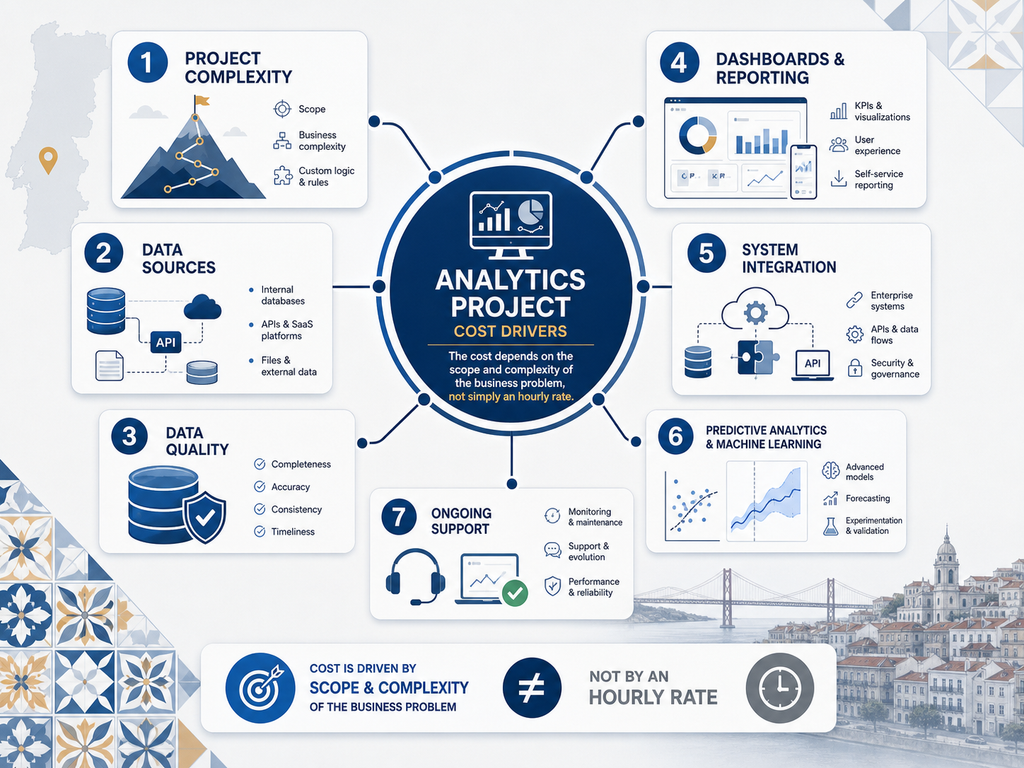
The hourly rate is only one part of the cost. In reality, the total price depends primarily on the amount of discovery, preparation, engineering, analysis, and implementation required to complete the project. While the dashboard is the most visible part, the most valuable work may lie in the infrastructure and processes behind it.
Project complexity
A simple project could consist, for example, of creating a sales dashboard in Power BI from a properly structured Excel file.
On the other hand, a more complex project may involve:
- Defining business metrics
- Reconciling differing values between departments
- Creating a reporting architecture
- Developing automated data pipelines
- Integration between different systems
Therefore, simple dashboards tend to require less work than comprehensive analytics programs because there are fewer components, dependencies, and risks to manage.
Data sources and systems
The number and type of data sources also directly influence the cost. A company that works with two or three structured sources—such as a CRM, an e-commerce platform, and accounting software—may require relatively little integration.
However, costs can increase when data is distributed across:
- Multiple databases
- Legacy applications
- Spreadsheets
- Marketing platforms
- APIs
- Cloud systems
- Tools used by different departments
Furthermore, each additional system can introduce problems related to data access, different settings, duplicate records, update frequency, and security.
Data quality
Data quality is often one of the least visible—but most important—factors in the cost of an analytics project.
Data may contain:
- Missing values
- Inconsistent customer IDs
- Duplicate records
- Different product names
- Incomplete dates
- Unclear metric definitions
As a result, considerable time may need to be invested in cleaning, validation, and normalization before the analysis produces reliable results. A consultant cannot produce consistent insights from unreliable data without first addressing these issues.
Dashboard and reporting requirements
A single executive dashboard with a few defined KPIs is very different from a reporting solution used simultaneously by sales, marketing, finance, operations, and management teams.
Costs may increase when the project requires:
- Multiple dashboards for different users.
- Access and permissions by role
- Automatic and scheduled reporting
- Drill-down analysis
- Custom calculations and data models
- Training and documentation
- Continuous changes to dashboards
Therefore, it is important to define in advance who will use the dashboards and what decisions they should support.
Integration requirements
Integrating systems is usually more complex than simply linking a dashboard to a spreadsheet.
Depending on the project, it may be necessary to develop:
- Integrations via APIs
- Data pipelines
- Data warehouses
- Automatic update processes
- Authentication systems
- Monitoring
- Error handling
Furthermore, more advanced cloud and data engineering environments may require specialized skills. Consequently, both the hourly rate and the total project budget may increase.
Predictive analytics
Descriptive analysis answers questions such as: “What happened?”
Predictive analytics seeks to answer questions such as: “What might happen next?”
or
“Which customers are most likely to leave the company?”
Projects involving forecasting, customer segmentation, lead scoring, demand forecasting, or machine learning models require more advanced skills. Furthermore, these projects may involve model validation, monitoring, and maintenance. Therefore, they typically have a higher cost than traditional dashboard or reporting projects.
Continuous support
Many companies need support after the initial implementation.
A monthly data analytics service may include:
- Dashboard update
- Creating new KPIs
- Data problem solving
- Performance optimization
- User support
- Documentation
- Model improvement
- New reports and analyses
This work is typically contracted separately through a monthly fee, hourly package, or service level agreement (SLA) .
How Company Size Affects Data Analytics Costs
Small Businesses vs. Larger Organizations
A small business with organized data from two or three sources may need a relatively simple analytics project.
For example, a consultant can integrate CRM, sales, and marketing data, create a practical dashboard, and identify opportunities for improvement.
- Conversion
- Retention
- Campaign performance
- Sales
On the other hand, a larger organization may have fragmented systems, multiple databases, inconsistent definitions, legacy software, and different reporting requirements across departments.
In this scenario, a significantly longer preparation phase will likely be necessary.
This first phase may include:
- Data mapping
- Data quality assessment
- Systems integration
- Definition of KPIs
- Data governance
- Reporting architecture
Thus, once again, the dashboard represents only a part of the total work.
Why Hourly Rates Can Be Misleading
Comparing consultants solely based on hourly rates or the initial price quoted can be misleading.
A vendor with a lower rate may seem cheaper initially. However, the outcome may be limited if the project does not address issues related to data quality, integration, metric definition, or team adoption.
On the other hand, a more experienced consultant may charge a higher rate, but complete the work more quickly, avoid costly mistakes, and create a solution capable of supporting better decisions over time.
Therefore, the most useful question is:
What business problem will this project solve, and what measurable value can it create?
For example, the value could result from:
- Reduce the time spent on manual reporting.
- Improve the distribution of marketing investment.
- Identifying higher-value customers
- Reduce churn
- Improve sales forecasts
- Automate recurring analyses
- Improve decisions related to inventory and operations.
- To create a single, reliable view of performance for management.
How do Data Analytics Consultants Charge?
Hourly or Daily Rates
This model is useful when requirements are not yet fully defined or when the company needs specialized skills in a flexible way.
It may be suitable for:
- Discovery
- Consultancy
- Exploratory analysis
- Technical support
- Projects in progress
Fixed Price Projects
A fixed price may be appropriate when the scope, requirements, and deliverables are clearly defined.
This model can facilitate budget planning because the company knows the agreed-upon cost for the project in advance.
Monthly Agreements
A monthly agreement can be useful when the company needs ongoing support for:
- Reporting
- Dashboard maintenance
- Data analytics
- Optimization
- Technical support
- Evolution of solutions
Ultimately, the appropriate pricing model depends on the nature of the project. A fixed price can provide greater predictability, while an hourly rate or a fixed-price contract can offer more flexibility as requirements evolve.
When should you hire a data analytics consultant?
When analyzing proposals from data analytics consultants in Portugal , focus on business results and not just price.
A good proposal should clearly explain:
- What is the business problem to be solved?
- What data sources are included and excluded?
- What cleaning or integration work will be required?
- What will be the main deliverables?
- Whether dashboards, models, pipelines, or training will be created.
- What are the assumptions, risks, and dependencies?
- What are the phases and timeline of the project?
- Who will be responsible for the dashboards, code, models, and documentation?
- What are the options for ongoing support?
- How will success be measured?
Portugal has a growing technology and consulting ecosystem, providing companies with access to different specializations and pricing models. However, the lowest budget does not necessarily represent the best value, just as the highest hourly rate does not necessarily mean that the project will be more expensive overall.
The most important thing is to understand if the consultant can grasp your business, work effectively with your data, and deliver a solution that improves how your organization functions. Before comparing prices, first define the business problem you want to solve.
Then ask each consultant:
- How would you approach the project?
- What data would be needed?
- What would be delivered?
- How would success be measured?
In this way, you will have something far more useful than a simple hourly rate: a way to assess the potential value of the project for the company.
Data Analytics for Businesses in Portugal
At BluTree , we help companies in Lisbon and throughout Portugal transform business data into actionable insights through data analytics, business intelligence, and customized data solutions.
Schedule a consultation with BluTree IT Solutions to discuss your data analytics challenge and understand how your data can support more informed business decisions.
Recommended for you:
Data Analysis in the Portuguese Real Estate Market: Predicting the Next Market Shift
Real-Time Data Integration Services in Portugal: Automate Business Reporting with BluTree
Frequently Asked Questions about the Cost of Data Analytics Consulting in Portugal
The cost depends on the scope of the project, the complexity of the data, the consultant’s experience, and the contracting model. Simple projects tend to cost less than projects with data integration, predictive analytics, or ongoing support.
A basic Power BI dashboard can cost several thousand euros. However, solutions with multiple data sources, data modeling, automatic updates, custom KPIs, and access control can have a significantly higher cost.
A freelancer might be suitable for a specific task or a simple dashboard. A consultant might be more suited for larger projects involving multiple data sources, integration, data engineering, business intelligence, project management, and ongoing support.
It depends on the project. Hourly billing can work well for exploratory or flexible work, while a fixed price may be suitable when requirements are clearly defined. For ongoing needs, a monthly fee may be an option.
The proposals can include very different levels of work. One might cover just a dashboard with pre-prepared data, while another might include data cleaning, systems integration, KPI development, documentation, training, and support.
It can have an influence. Projects involving personal data may require additional measures related to access control, data minimization, security, retention, documentation, and governance. The impact depends on the type of data and the project requirements.
Measure business results, not just dashboard data. Some useful indicators include reduced reporting time, fewer errors, faster decisions, better forecasts, improved marketing performance, higher retention, and reduced operating costs.