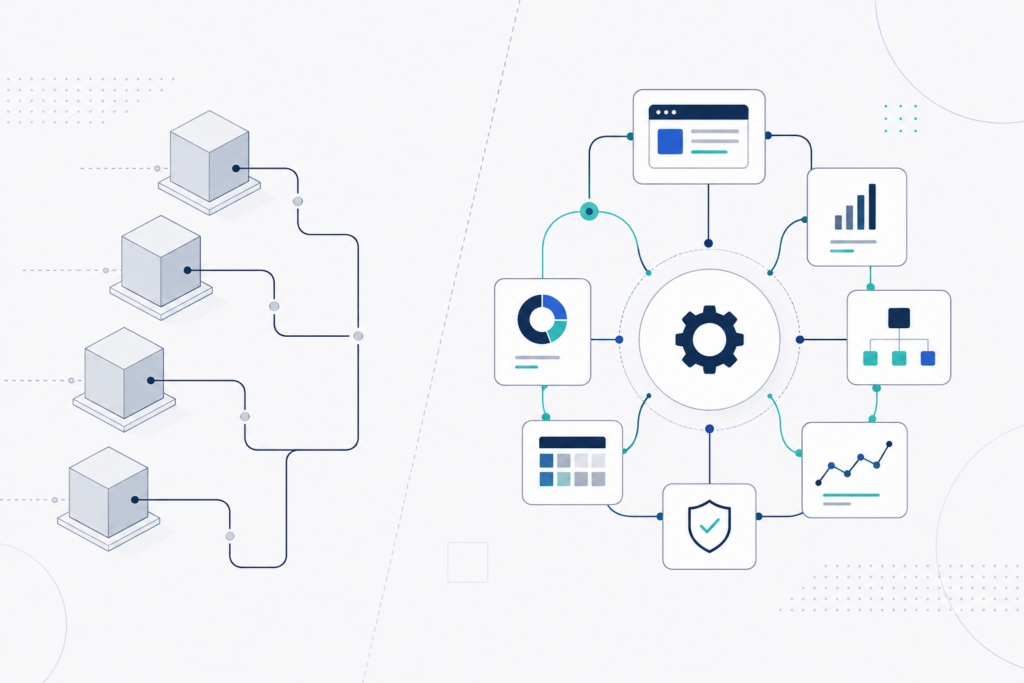
Many companies in Portugal face a dilemma when looking for an AI and business automation partner or consultant. After all, there are increasingly more solutions, platforms, and suppliers on the market. Therefore, it can be difficult to understand which approach is most suitable for the company. In this guide, we will analyze the main mistakes to avoid and, above all, the criteria that can help identify the most suitable AI consultant for your business. AI and business automation can help SMEs, startups, and medium-sized companies in Portugal reduce repetitive work, improve customer service, connect isolated systems, and accelerate decision-making. However, a successful AI implementation doesn’t simply begin with buying a tool or creating a chatbot. It begins with understanding a real business problem.
The challenge is that a company can easily choose the wrong technology, an inappropriate implementation approach, or even the wrong AI consultant.
At BluTree , we believe that AI should be practical. That is, the right solution should adapt to how the company works, solve a measurable problem, and be able to keep pace with the growing needs of the business. Furthermore, this topic is particularly relevant in Portugal. The National Digital Strategy 2026–2027 includes the digitalization of companies and the responsible adoption of AI among its priorities.
Therefore, in this guide we analyze 7 common mistakes that companies should avoid when choosing an AI consultant in Portugal.

Mistake #1: Choosing the technology before defining the problem.
A very common mistake is to start with a statement like:
“We need AI.”
That’s understandable. However, that statement doesn’t yet constitute a business case.
AI is not an end in itself. Instead, it is a technology that can be useful when it solves a specific operational challenge.
Therefore, before choosing a platform or tool, the company must identify where it is wasting time, money, information, or quality in the customer experience .
For example, the problem could be:
- Customer support teams repeatedly answer the same questions.
- Salespeople spend too much time manually updating records in the CRM.
- The finance teams process invoices and documents manually.
- Management reports take days to prepare, using multiple spreadsheets.
- Customer data is distributed across systems that do not communicate with each other.
- The company cannot accurately predict demand, sales, churn, or cash flow.
When the underlying problem is clear, the technological decision becomes much simpler.
The solution could be an AI assistant, workflow automation, document processing, CRM automation, predictive analytics, or improved reporting . In some cases, AI may not even be necessary.
At BluTree , we start with the operational problem and then identify the most suitable combination of AI, automation, data integration, and process improvement .
Look for an AI consultant who starts with the problem. A good consultant should first seek to understand what the company needs to improve . Only then should they recommend the most appropriate technology.
Mistake #2: Choosing an AI consultant based solely on price.
Cost is important, especially for SMEs and startups working with limited budgets. However, choosing an AI consultant solely because they offer the lowest price can end up being more expensive in the long run.
A low-cost implementation might, for example, not include essential work such as:
- Map the existing process before automating it.
- Clear and connect the necessary data.
- Integrate the systems correctly.
- Test the workflow with real users.
- Train the employees.
- Document the solution.
- Provide support after implementation.
- Monitor accuracy, reliability, and business impact.
Therefore, a more useful question is not simply: “How much will it cost?”
The question is: “What measurable value can this solution create, and what work is involved in making that value possible?”
A good AI or automation implementation should solve a concrete problem, such as:
- reduce manual labor;
- reduce response times;
- accelerate reporting;
- Reduce avoidable errors;
- eliminate operational bottlenecks;
- Reduce customer waiting times;
- or to better take advantage of business opportunities.
Recommended: AI and Business Automation Solutions for Companies in Portugal .
Mistake #3: Choosing AI expertise over business knowledge
Technical knowledge of AI is important. However, it is not enough on its own. An effective consultant needs to understand how the company works in practice: its workflows, teams, systems, customers, data, risks, and decision-making processes. After all, a technically impressive AI model or AI agent can fail if it is not integrated with the tools used daily or if it creates a process that employees cannot realistically follow.
For example, a customer support chatbot should not be evaluated solely on its ability to generate fluent responses.
You also need:
- to integrate into the support process;
- obtain reliable information;
- Recognize when you should forward the request to a person;
- Maintain proper records;
- and allow the team to review the interactions.
Similarly, CRM automation should reflect the actual sales process.
Automating a poor lead qualification process, incomplete records, or unclear information transfer processes only makes a weak process run faster .
At BluTree, we combine AI strategy and adoption with process automation, CRM and ERP automation, data integration, AI assistants, chatbots, document processing, predictive analytics, and custom AI applications .
Therefore, the focus is not only on what the technology can do. It is, above all, on understanding whether the solution will work for your company .
Mistake #4: Starting with an unnecessarily large AI project
Sometimes, companies assume that AI adoption must begin with a large transformation program. However, this approach can delay results, increase risk, and make it harder to demonstrate value. Therefore, a focused pilot project may be a more practical approach.
Instead of trying to transform the entire company all at once, consider starting with a clearly defined process, such as:
- Automating a process with many documents, such as processing invoices or orders.
- Create a customer support assistant for a limited set of frequently asked questions.
- Connecting CRM and marketing data to improve lead tracking.
- Automate an approval workflow using Power Automate.
- Create a forecasting model for a product category, location, or customer segment.
- Create a management dashboard from a limited set of reliable data sources.
An effective pilot project should have:
- limited scope;
- clearly defined person in charge;
- realistic access to data;
- and measurable success criteria.
If the pilot generates results, the company can then expand the solution with greater confidence. This approach is particularly useful for SMEs and startups in Portugal. In addition to allowing the development of internal knowledge, it reduces implementation risk and avoids committing significant resources before the solution demonstrates its usefulness.
Error #5: Ignoring employee adoption
Even a technically well-executed AI or automation project can fail if employees don’t understand, trust, or simply don’t use the solution. For example, employees may fear that AI will replace certain functions, reduce their autonomy, produce incorrect results, or add administrative work. These concerns should not be ignored. They are part of the implementation itself.
Therefore, effective adoption requires clear communication about:
- What the tool does and doesn’t do.
- What tasks continue to be performed by people?
- How should employees review or question results generated by AI?
- How are errors and exceptions handled?
- Where employees can get support.
- How will feedback be collected and used to improve workflow?
Furthermore, in areas such as customer service, finance, HR, and other high-impact contexts, human oversight can be particularly important. The European Union’s AI Act follows a risk-based approach. However, the specific obligations vary depending on the type and context of the system.
At BluTree, we treat adoption as an integral part of the project, not as a later step. The solution naturally needs to be technically sound. But it must also make daily work clearer and more efficient for the people who will use it.
Recommended: Business Intelligence Solutions for Companies in Portugal .
Error #6: Ignoring existing data, systems, and processes.
AI does not automatically correct poor-quality data, disconnected systems, or unclear processes. If customer data is incomplete, product information is inconsistent, CRM records are not maintained, or financial and operational systems fail to exchange information, the AI solution will inherit many of these limitations.
Therefore, before implementation, companies should evaluate:
- Which systems contain the necessary information?
- If the data is current, accurate, and sufficiently complete.
- Who is responsible for each data source?
- How will the systems be connected?
- What access controls are needed?
- If business definitions are consistent across teams.
- What data should not be made available to an AI tool?
Sometimes, therefore, the first right project is neither a chatbot nor a predictive model.
Alternatively, it could be:
- Data integration;
- CRM data cleansing;
- standardization of documents;
- or workflow redesign.
These foundations can make future AI projects more reliable, secure, and valuable. BluTree supports this work through data integration, ERP and CRM automation, Microsoft Fabric, Azure AI, Power Automate, and custom AI applications.
The goal is to create an environment where automation and AI can work reliably, rather than adding yet another isolated tool to the existing infrastructure.
Mistake #7: Not defining what success means.
Without clear metrics, it becomes difficult to determine if an AI project has truly worked.
“Implementing an AI assistant” is an activity.
On the other hand:
“Reduce the average first response time by 30%, while maintaining customer satisfaction”
It is a measurable objective.
Therefore, before starting implementation, define what improvement the project should produce.
Depending on the use case, it may include:
- Fewer hours spent on manual processes.
- Faster responses to customers.
- Shorter document processing time.
- Fewer errors or rework.
- Higher lead conversion rate.
- Greater data completeness in the CRM.
- Better sales or demand forecasts.
- Faster access to management information.
- Reduction of operational costs.
- Greater customer or employee satisfaction.
Furthermore, it is important to establish a baseline . If a process currently takes five days, involves three people, and has a rework rate of 10%, this data allows us to objectively measure whether automation has produced a real improvement.
Responsible AI, GDPR, and AI Act in Portugal
For companies operating in Portugal, the adoption of AI should include governance, data protection, and security from the outset .
The AI Act applies in the European Union, including Portugal, while the GDPR remains relevant whenever personal data is processed.
Furthermore, the Portuguese National Digital Strategy places security, protection, ethics, trust, and transparency among its principles, while also establishing objectives for the digitalization of companies and the adoption of AI.
In practice, for many business use cases, some of the first steps are relatively simple:
- Knowing what customer, employee, supplier, or financial information is being used.
- Utilize appropriate platforms and access controls.
- Ensure that employees understand when they are using AI.
- Review AI results before using them in important decisions.
- Maintain a pathway for human intervention.
- Avoid high-impact decisions without adequate governance and expert advice.
- Document the project’s objective, scope, responsible parties, and expected results.
And what will change with the AI Act in 2026?
The transparency obligations outlined in Article 50 of the AI Act came into effect on August 2, 2026. Among other situations, certain solutions that interact directly with people must inform the user that they are interacting with an AI system. There are also specific rules regarding certain content generated or manipulated by AI.
However, these obligations do not mean that all uses of AI have exactly the same requirements. The framework depends on the type of system and how it is used.
Therefore, companies should confirm the requirements applicable to their specific case and seek legal or data protection advice when necessary.
Recommended: Cloud Infrastructure & Data Engineering Solutions for Businesses in Portugal .
What should you look for in an AI consultant?
A good AI consulting collaboration should begin with discovering and analyzing the business, not with a pre-selected tool.
Before making a recommendation, a consultant should seek to understand:
- The business problem that needs to be solved.
- How the workflow currently functions.
- What data and systems already exist?
- How can technology be integrated?
- What are the security, privacy, and compliance requirements?
- Whether the problem requires automation, AI, or simply process improvement.
- How can a focused pilot project be created?
- How will the success criteria be defined and measured?
- How will the adoption process be carried out by employees?
- What support and optimization will be available after implementation?
How BluTree Helps Companies in Portugal Adopt AI and Automation
BluTree works with SMEs, startups, and medium-sized companies in Portugal that aim to transform AI and business automation into concrete operational improvements.
Our services include:
- AI adoption strategy and planning.
- Business process automation.
- Implementation of Microsoft Copilot.
- Solutions with Power Automate.
- AI agents and AI assistants.
- Chatbots and customer service automation.
- Automation of document processing.
- Predictive analytics and machine learning.
- CRM and ERP automation.
- Financial and accounting automation.
- Data integration and Microsoft Fabric solutions.
- Azure AI, OpenAI, and ChatGPT Enterprise solutions.
- Developing customized AI applications.
The goal is simple: to help your company identify where AI and automation can create real value , develop solutions that integrate with existing operations, and support teams in their use.
Choosing the Right AI Consultant in Portugal
Choosing an AI consultant therefore doesn’t mean finding the company with the longest list of technologies. Instead, it means finding a partner who understands your business, can identify where AI or automation can create real value, and has the capacity to implement those solutions responsibly.
For SMEs and growing companies in Portugal, a practical approach often involves starting with a well-defined operational problem, testing a focused solution, measuring the results, and then scaling up.
AI should help the company function better — not simply make the technology more complex.
Ready to Explore AI and Business Automation?
You don’t need to start with a major AI transformation.
A focused conversation can help identify the processes that are creating the most friction, the data and systems that already exist, and the areas where automation or AI can generate the clearest return.
Contact the BluTree team to discuss your AI strategy, workflow automation, customer service automation, CRM or ERP integration, data analytics, or custom AI application development.
Frequently Asked Questions about AI and Business Automation
Look for a consultant who understands your business objectives, can identify practical AI and automation opportunities, has relevant technical skills, and can define measurable results.
No. Price is important, but it should be analyzed together with experience, project scope, integration, security, support, and expected business value.
Start with the problem, not the technology. Repetitive manual processes, inefficient workflows, slow reporting, document processing, and customer service bottlenecks can all indicate opportunities for automation or AI.
One of the most common mistakes is starting with the technology without first defining the desired business outcome. First, the problem must be identified; then, it must be evaluated whether the best solution is AI, automation, or another technology.
Industry experience can be helpful because it allows for a better understanding of workflows, challenges, and specific requirements. However, knowledge of business processes and technical skills are also important.
This is crucial when the solution processes personal data, customer data, employee data, or other sensitive information. Ask the consultant how they address data protection, access, security, and information handling.
Ideally, yes. AI and automation solutions may require ongoing monitoring, optimization, user support, updates, and improvements. A long-term partner can help maintain the value of the solution as the business evolves.