Are you looking for a data analytics consultant in Portugal ?
In this case, the goal should be to find a partner capable of transforming your company’s data into better decisions — and not simply someone who creates dashboards or reports.
A good data analytics consultant helps companies identify growth opportunities, improve operational efficiency, understand customer behavior, automate reporting, and establish reliable performance metrics.
In this guide, we present 7 essential factors to consider when choosing a data analytics consultant in Portugal , from experience in your sector and technical skills to business understanding, reporting capabilities, and long-term strategic value.
At BluTree , we help startups, SMEs, and growing companies in Portugal transform fragmented data into actionable insights through business intelligence, data analytics, automated reporting, modern data platforms, and data-driven decision making .
Why should a company hire a Data Analytics consultant?
Companies are currently generating more data than ever before.
For example:
- Website traffic data;
- data on customer behavior;
- sales data;
- Inventory data;
- marketing campaign performance;
- financial and operational metrics.
However, the real challenge lies not only in collecting data.
It’s about using them effectively.
Therefore, the value of a consultant is not simply to produce yet another report. On the contrary, a good analytics partner helps to connect the data the company already has to the questions the business needs to answer.
A data analytics consultant can help companies to:
- Identify opportunities that might otherwise go unnoticed;
- reduce operational inefficiencies;
- to improve customer acquisition and retention;
- Analyze and support forecasts of future performance;
- to support strategic decisions;
- Create sustainable reporting systems.
In this way, instead of relying solely on intuition, companies can make decisions supported by evidence, metrics, and measurable results .
7 steps to choosing the right Data Analytics consultant for your company
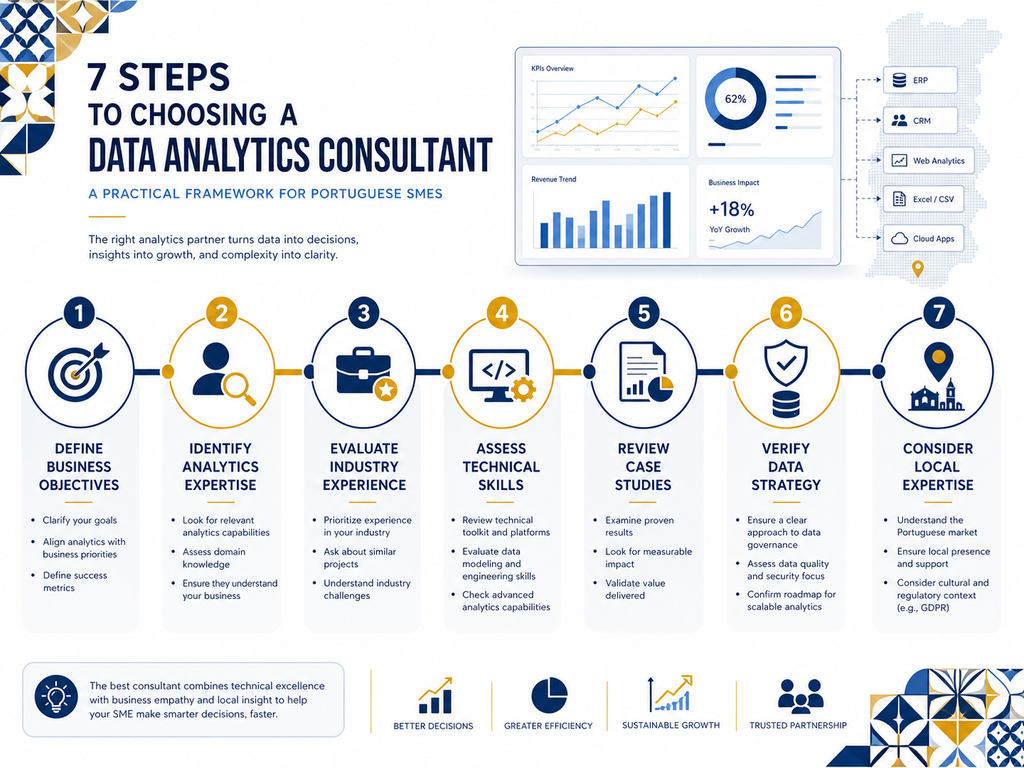
Step 1: First, define your business objectives.
Before contacting any consultant, clearly define what you want to achieve.
Many analytics projects start by focusing on the tools, when they should start with the business results .
Ask yourself:
- Want to increase revenue?
- How to improve customer retention?
- Reduce costs?
- Optimize inventory?
- Automating reporting?
- How to improve marketing ROI?
- Creating dashboards for administration?
For example:
Startup
A startup may need performance dashboards that track growth metrics and provide reporting for investors.
SME
An SME may want to gain greater visibility into sales performance across different locations.
E-commerce company
An e-commerce company might look for customer segmentation, conversion analysis, and insights into product profitability.
The clearer your objectives are, the easier it will be to evaluate potential consultants.
Therefore, a consultant who starts by asking about your business objectives is, from the outset, a more positive sign than someone who immediately starts by recommending a particular software platform.
Step 2: Determine what type of Analytics experience you need.
Data analytics encompasses several areas. However, not all consultants specialize in all of them.
Business Intelligence
It is particularly suitable for companies that need to improve reporting, dashboards, KPIs, and visibility into business performance. Learn more about our Business Intelligence services .
Data Analytics
It’s useful when you need to better understand performance, trends, customer behavior, or operational issues. Learn about our Data Analytics services .
Predictive Analytics
This is relevant when a company intends to use historical data to analyze trends and support predictions about possible future outcomes.
Data Engineering
This is important when data is fragmented across multiple systems and needs to be integrated, processed, or automated before it can be effectively analyzed. In practice, these capabilities may overlap.
Therefore, a good analytics partner should be able to explain which combination of services your company really needs, instead of trying to sell you every available solution.
Step 3: Assess the experience in your sector.
Relevant industry experience can significantly reduce the learning curve. Furthermore, it helps the consultant to more quickly understand the business issues behind their data. While strong analytical skills are fundamental, industry knowledge can accelerate implementation and contribute to more relevant recommendations.
Startups
Seek experience in:
- growth metrics;
- Reporting for fundraising;
- SaaS KPIs;
- customer acquisition.
SME
Seek experience in:
- operational efficiency;
- business process improvement;
- financial reporting.
E-commerce
Seek experience in:
- Customer Lifetime Value (CLV);
- conversion rates;
- Abandoning a shopping cart;
- marketing attribution;
- Product analytics.
Retail and Hospitality
Look for skills in:
- Demand forecast;
- customer segmentation;
- Inventory optimization.
Real Estate
Seek experience in:
- Real estate market data;
- price trends;
- Demand analysis;
- investment analysis;
- demographic indicators.
Consequently, a consultant who has already solved similar challenges will be able to understand certain opportunities more quickly.
Step 4: Assess technical skills and knowledge of tools.
A competent analytics consultant should understand the tools needed to solve your problem. However, technical knowledge should serve the business objective—not become the objective itself.
Analytics and Business Intelligence : Power BI, Excel and Microsoft Fabric.
Data : SQL, databases, and data warehouses.
Cloud : Azure and other cloud platforms.
Marketing and customer data : GA4, CRM, and e-commerce platforms.
The goal is not to find the consultant who knows the most tools. It’s to find the consultant who knows the tools that are right for your company’s requirements.
Step 5: Analyze case studies and previous results.
Always ask for examples of previous work. But there’s an important difference: Don’t just ask what they built. Ask what they changed.
A dashboard is a technical outcome. On the other hand, greater visibility into the business, faster reporting, cost reduction, or improved decision-making are business outcomes. Furthermore, the best consultants should be able to demonstrate the impact of their work, not just present a list of features or deliverables. Therefore, focus on impact, not just features.
Instead of asking, “Can you create dashboards?”
Ask: “What business results were you able to achieve through these dashboards?”
Step 6: Analyze the approach to the data strategy.
A good consultant does more than produce reports. They must also understand how the data supports the company’s broader objectives.
Therefore, ask how they approach topics such as:
- KPI development;
- data governance;
- data quality;
- performance measurement;
- change management.
More importantly, a good analytics partner should help management answer business questions, rather than simply delivering visualizations. If conversations immediately begin with choosing software before there is a clear understanding of the company’s objectives, this deserves attention. First, the problem must be understood. Then the technology can be chosen.
Step 7: Consider the advantages of working with a Portuguese consultant.
Remote collaboration has become commonplace. Even so, local expertise can remain relevant. Consequently, a data analytics consultant in Portugal can offer several advantages, such as:
Better understanding of the market
A local consultant may be more familiar with:
- Portuguese business culture;
- consumer behavior;
- regulatory requirements.
Simpler collaboration
When necessary, in-person workshops can facilitate communication and accelerate certain phases of the project.
Same time zone
Communication can become faster and more efficient when both teams work in the same time zone.
Long-term relationships
Many analytics projects evolve over time. Therefore, local availability can facilitate monitoring, support, and continuous improvement of the solution.
For companies located in Lisbon, Porto, Braga, Coimbra, or other regions of Portugal, working with a local partner can bring additional advantages. However, it’s important not to confuse geographical proximity with capability. The ability to understand your business, demonstrate relevant expertise, and generate measurable results is more important than simply having an address in Portugal.
Bonus: How much does a Data Analytics consultant cost in Portugal?
One of the most frequently asked questions by companies is:
“How much does a data analytics consultant cost in Portugal?”
The answer depends on several factors. Industry pricing directories indicate that many BI and data consulting firms working with the Portuguese market charge hourly rates that can vary approximately between €25 and over €100 per hour , depending on experience, project complexity, and company size.
Therefore, there is no single price applicable to all projects. The final cost may depend on, among other factors:
- number of data sources;
- complexity of the analysis;
- reporting requirements;
- Required integrations;
- tools used;
- continuous support level.
To delve deeper into this topic, please also consult our article on Data Analytics consulting pricing in Portugal .
How to choose the right Data Analytics consultant
Choosing a data analytics consultant is ultimately less about finding the person who knows the most tools and more about finding a partner who understands what your company needs to achieve.
Before making a decision, ask yourself:
Do you understand our objectives?
Have you solved similar problems before?
Can they work with our existing data and systems?
Can they transform analysis into business decisions?
A good analytics partner shouldn’t simply provide your company with more reports.
It should help her understand:
What is happening, why is it happening, and what can you do next?
For Portuguese startups and SMEs, this can transform data from an underutilized business resource into a practical tool for improving performance, managing uncertainty, and identifying new opportunities .
Data, privacy and GDPR
It is important to emphasize that, for companies operating in Portugal and the European Union, data privacy cannot be ignored.
The GDPR — General Data Protection Regulation — establishes requirements regarding the collection, storage, and processing of personal data.
Therefore, data protection should be considered as part of the analytics strategy from the very beginning of a project, especially when personal data is involved.
This topic will be developed in a future article.
Find a Data Analytics Consultant in Portugal
For companies seeking a data analytics partner in Portugal, BluTree works with startups and SMEs in Lisbon and throughout the country.
We help organizations transform business data into clearer reporting, better insights, and more informed decisions .
If you are evaluating an analytics project, schedule a virtual consultation with our team or send us an email .
Recommended articles
- Real-Time Data Integration Services in Portugal: Automate Reporting and Business Insights
- Data Analysis in the Portuguese Real Estate Market: Predicting the Next Market Shift
Frequently Asked Questions When Hiring a Data Analytics Consultant
A data analytics consultant helps companies collect, organize, and analyze their data to identify trends, improve performance, solve operational problems, and support better business decisions.
An analytics consultant can help an SME transform fragmented data into useful insights, reduce manual reporting, identify inefficiencies, and make evidence-based decisions instead of assumptions.
The cost varies depending on the project’s complexity, the number of data sources, reporting requirements, integrations, and the level of support needed. Therefore, clearly defining the project’s objective is usually the best starting point for estimating the investment.
Look for a consultant who combines technical skills, business understanding, relevant industry experience, proven results, and the ability to work with your data, systems, and objectives.
It depends on your needs. If the main goal is to create dashboards, reporting, and KPI visualization, a Power BI consultant might be suitable. On the other hand, if you need more comprehensive analysis, forecasting, data integration, or strategic insights, you could benefit from broader data analytics services.
Yes. A good analytics consultant should be able to work with existing databases, spreadsheets, CRM, ERP, cloud services, and other business systems. Furthermore, integrating existing data is often an important part of an analytics project.
Local experience can bring advantages, such as greater familiarity with the Portuguese business environment, simpler communication, and the possibility of face-to-face collaboration. However, industry experience, technical skills, and measurable business results should remain fundamental criteria.