
All real estate decisions begin with some degree of uncertainty. Whether you’re investing in a new property in Portugal, expanding a rental portfolio, or advising clients on market opportunities, there’s always a fundamental question: “Is this the right time?” More importantly: where is the real estate market heading? Increasingly, analyzing real estate market data in Portugal is helping companies and professionals in the sector gain more relevant insights into the market. At BluTree , we’ve developed an algorithm that combines different indicators to generate insights that can support investors and other real estate professionals in making more informed decisions.
For decades, these decisions relied primarily on experience, intuition, and historical reports. While these elements remain valuable, today’s real estate market generates more information than ever before.
From demographic shifts and financing conditions to consumer confidence and broader economic trends, the real estate market is currently producing a wealth of relevant signals.
The challenge lies in transforming these signals into useful information for the business.
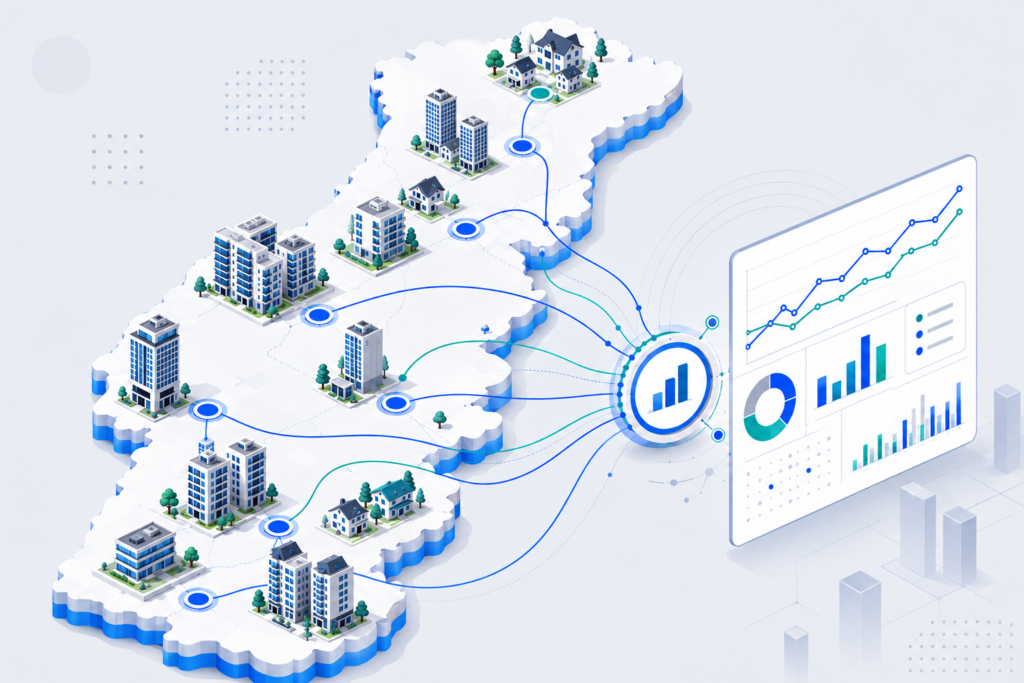
The real estate market in Portugal and the role of data analysis.
The Portuguese real estate market has undergone a significant transformation over the last decade. Population movements, changes in housing credit conditions, tourism growth, international investment, and shifts in consumer confidence have influenced the demand for properties in various ways.
For real estate professionals, understanding how these factors interact is becoming increasingly important.
Analyzing only past prices rarely allows one to fully understand the reality of the market.
At BluTree IT Solutions , we believe that real estate data analytics can complement market expertise.
We also know that nothing replaces the experience of someone who knows the market. Real estate market trends in Portugal go far beyond simply observing prices when it comes to investment decisions.
That is why we developed a system designed to identify signals that may indicate changes in the Portuguese real estate market cycle.
But this is not just a project about algorithms or econometrics.
It is, above all, a project about making better decisions.
It’s about understanding what data means for the people and organizations that influence and participate in the market — real estate developers, investors, brokers, financial institutions, and public decision-makers.
By bringing together different economic and market indicators into a single analytical framework, companies can begin to identify patterns that might remain hidden when each indicator is analyzed in isolation.
These insights can help organizations to:
- plan investments;
- conduct market research;
- Manage real estate portfolios;
- to support expansion strategies;
- assess risks;
- Identify changes in demand;
- to support real estate development decisions.
Do we need data analysis in the Portuguese real estate market?
Imagine a real estate developer evaluating two municipalities for a new project.
A traditional analysis might compare, for example, average selling prices.
A more data-driven approach could also consider issues such as:
- Is population growth sustaining long-term demand?
- How are financing conditions evolving?
- Is buyer confidence increasing or decreasing?
- Are there changes in interest rates that could influence demand?
- How are employment levels evolving?
- Is the demand for rentals changing?
- Are immigration and population mobility altering local demand?
- Are broader economic trends creating opportunities or increasing uncertainty?
In this context, relying solely on experience or intuition may not be enough.
Real estate developers can use additional data to support decisions related to acquisitions, location, and the launch of new projects.
Investors can track changes in market conditions before they become apparent through a single indicator.
Banks and financial institutions can obtain additional context when assessing the risk associated with mortgage loans.
Real estate consultants and agencies in Portugal can use data to supplement the guidance provided to their clients.
Public policymakers can obtain additional information about potential market imbalances.
The goal is not to replace professional experience.
It’s about reinforcing it with information.
Analyzing multiple indicators together can provide a more comprehensive view of the market than using a single statistic.
What can the data reveal about the real estate market in Portugal?
This approach forms the basis of one of BluTree’s ongoing research initiatives on the residential real estate market in Portugal.
Instead of analyzing isolated indicators, the project explores how different economic and market signals can work together to improve market understanding and support more informed decisions.
The research continues to evolve, but one broader conclusion is already becoming evident:
Companies can increasingly benefit when strategic decisions are supported by structured and reliable data.
Why is this important for the Portuguese real estate market?
Portugal continues to attract international investors, digital nomads, institutional capital, and domestic buyers.
At the same time, changes in interest rates, immigration patterns, and economic uncertainty have increased market complexity.
Companies that rely exclusively on historical prices may fail to detect some of the signals that influence future demand.
Combining real estate market expertise with data analytics allows organizations to better track changes in market conditions and support strategic decisions.
This approach can be particularly relevant when the following are at stake:
- analysis of investment opportunities;
- selection of locations;
- risk assessment;
- Real estate portfolio analysis;
- planning for new ventures;
- Demand analysis;
- expansion strategy;
- Monitoring market trends.
Conclusion: Does data analysis have a place in the Portuguese real estate market?
The real estate market in Portugal has never been so dynamic and complex.
Prices have evolved, demand has changed, and global factors have begun to have an increasingly significant impact on local realities.
Despite all this transformation, one challenge remains: anticipating market changes before they become evident.
The future of the real estate sector does not lie in replacing the judgment of professionals.
It involves strengthening it through better data and information.
As the Portuguese real estate market continues to evolve, organizations that combine industry expertise with quality data analysis can gain a stronger foundation for identifying opportunities, managing uncertainty, and supporting long-term decisions.
Our early warning system may be the real estate market analysis and intelligence tool your company didn’t know it needed.
At BluTree IT Solutions, we are committed to helping companies leverage this potential through data analytics, business intelligence, and technological solutions tailored to the needs of the Portuguese market.
To learn more about how data analytics can support your business, visit our services page .
Schedule a consultation with our Data Analytics Team to gain insights into changes in the real estate market that could benefit your real estate business.
Recommended for you:
Real-Time Data Integration Services in Portugal: Automate Business Reporting with BluTree
How We Created and Implemented a Secure Multi-Cloud Infrastructure for Businesses in Portugal
Frequently Asked Questions about Data Analysis in the Real Estate Market
Real estate data analysis involves collecting, cross-referencing, and analyzing information from various sources, such as property prices, demographic trends, interest rates, mortgage lending activity, and economic indicators.
The goal is to help individuals and businesses make more informed real estate decisions. Instead of relying solely on historical prices, data analysis provides a more comprehensive view of market conditions and emerging trends.
Data analysis can help investors identify trends, assess risks, and analyze investment opportunities in a more structured way.
By combining economic, demographic, and real estate information, investors can gain more context for decisions related to where and when to buy, develop, or expand a real estate portfolio.
No model can predict the future with absolute certainty.
However, advanced data analysis can identify patterns and indicators that may signal changes in market conditions.
These insights can support planning, reduce uncertainty, and improve strategic decision-making by companies operating in the Portuguese real estate market.
Real estate data analysis can be useful for a wide variety of organizations, including property developers, real estate agencies, investment firms, banks, credit institutions, asset managers, and public sector entities.
Any organization that makes decisions based on the Portuguese real estate market can benefit from reliable data and structured analysis.
Relevant data may include property prices, mortgage lending activity, interest rates, population growth, immigration trends, employment levels, consumer confidence, tourism activity, and other economic indicators.
Analyzing these factors together can provide a more comprehensive view of the market than analyzing property prices in isolation.
Yes. BluTree IT Solutions develops data analytics and business intelligence solutions that help organizations transform complex data into actionable business insights.
We develop secure and scalable analytics platforms tailored to the needs of each company, enabling them to support decision-making through structured and reliable data.
The Portuguese real estate market is influenced by a growing number of interconnected factors, including international investment, demographic changes, financing conditions, housing demand, and economic trends.
As the market becomes more complex, real estate data analysis can complement the expertise of professionals, support trend analysis, and contribute to long-term strategic planning.